

In numerical control machining, the tool holder serves as a "bridge" connecting the machine tool spindle and the tool, and its performance directly determines the machining accuracy, efficiency and stability. Faced with a wide variety of knife handle standards in the market, many practitioners are confused by terms such as BT, SK, ISO, and HSK. This article will deeply analyze the differences among these mainstream tool holders to help you choose the right tools and improve processing efficiency!
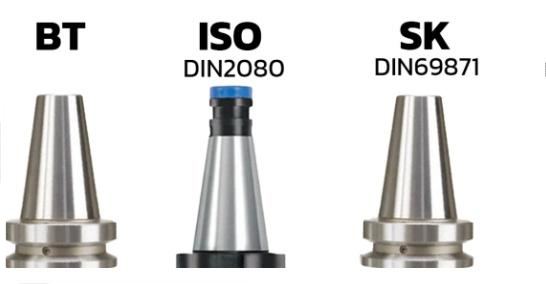
I. Standards and Structural Differences: Taper, contact Method and design concept
BT knife handle (Japanese standard)
Taper and positioning: It adopts a 7:24 taper and only contacts the main shaft through the taper surface, which belongs to a single-sided positioning system. Common specifications such as BT30, BT40, and BT50 are widely used in traditional processing scenarios.
High-speed shortcoming: When the rotational speed exceeds 10,000rpm, the centrifugal force will cause the main shaft hole to expand, the tool holder to be pulled deep into the spindle, causing the tool position to shift and the precision to decrease. Therefore, it is not suitable for ultra-high-speed processing.
2. SK handle (the "high-speed version" of BT)
Essence and Upgrade: SK is a high-speed model of the BT series. Its appearance is similar to that of BT, but by optimizing the material and structure (such as SK-specific nuts and clamps), the rotational speed can reach 40,000rpm, making it suitable for high-speed light cutting.
Limitations: Although the rotational speed has increased, it still relies on single-sided conical contact. At high speeds, there is still a problem of accuracy fluctuation caused by the expansion of the main shaft hole.
3. ISO knife Handle (International Standard)
Universality is king: Based on the ISO 7388/1 standard, it also adopts a 7:24 taper, but the size design is more flexible. For example, its D4 value is smaller than that of the DIN 69871 type tool holder, and it is compatible with various spindle interfaces such as DIN and ANSI, and is hailed as the "universal compatible tool holder".
Applicable scenarios: It is suitable for workshops where multiple models are mixed, but it has limited support for high-speed and high-rigidity demand scenarios.
4. HSK tool holder (German high-speed standard)
Double-sided positioning revolution: Adopting a dual positioning system with a 1:10 taper and end face contact, it achieves elastic deformation through a hollow thin-walled design, ensuring that the taper surface and the flange end face are closely adhered simultaneously at high speeds. Its rigidity is 5 to 7 times higher than that of BT/SK.




All rights reserved © 2024 Guangdong Guanshen Group All rights reserved, infringement must be investigated 粤ICP备2024178434号
Copyright © 2024 www.gs-group.com.cn All Right Reserved